Limited Series. A Dialogue between Art and Automobile
...More to follow shortly...
AFTER THE ALGORITHM
What does artificial «intelligence» mean for your job, your creativity, your community? Find out at After The Algorithm, a new 10-day festival for curious minds from all backgrounds: artists, researchers, builders – and you. Together, we'll explore how algorithms shape our lives. Question, explore, discuss, and reimagine with us. Come curious. Leave informed.
Supported by Stadt Zürich Kultur, the foundations Temperatio, Cassinelli-Vogel and Pro Litteris, ZHAW Digital, PHZH Center Digital Learning, Zürcher Hochschule der Künste and Swiss Center for Responsible AI. Project Partner: ETH AI Center, GenAI Zürich, Parlamentary Group Digital Sustainability, AI Lights, Theater Winkelwiese and Never Stop Reading. Produced by Silicon Stories. Curation: Adrian Notz. Design: Michael Hinderling & Dario Linke.
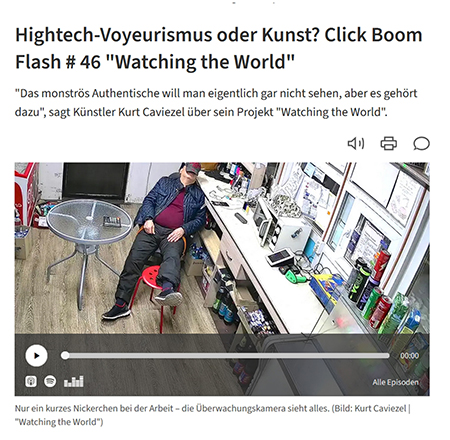
Click Boom Flash #46 — Watching the World
Kurt Caviezel sammelt weltweit frei zugängliche Webcams und verwandelt sie in eine gigantische Foto-Apparatur. Rund 15.000 Kameras liefern ihm Bilder, die alltägliche Szenen und intime Momente zugleich zeigen. Vom Skilift bis ins Krankenzimmer spannt sich die Sammlung, die streng genommen keine Fotografie im klassischen Sinn ist. Stattdessen wird sie zur globalen Linse, die Wahrnehmung und Datenschutz infrage stellt.
Genda #4 — The Violence of the State
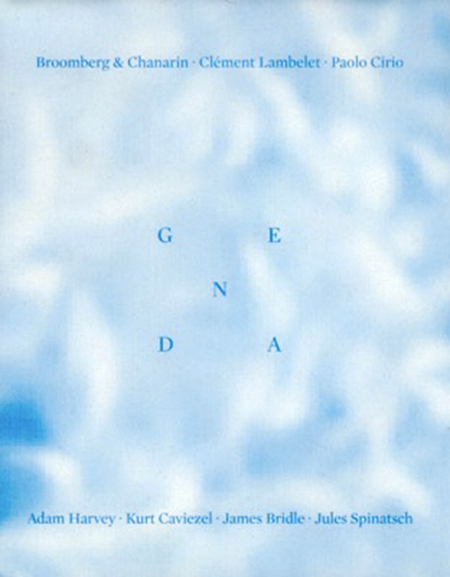
“The violence of the state is nothing other than the irruptive manifestation, in a way, of its own reason”. (Michel Foucault, Security, Territory, Population, 1978)
Text: Yang Fan. cm 17×21; pp. 136; COL; paperback.
Publisher: A&Mbookstore Edizioni, Milano, 2024.
ISBN: 9791281232082
Multi Multi — Photoworks Annual #31

Multi Multi, Photoworks’ 31st Annual Publication, is a deep dive into image replication. “…the mass reproduction of photographic images in books only became possible in the very specific conditions of the late nineteenth century and early twentieth century…” Michelle Henning, Photography: The Unfettered Image
Multi Multi (Photoworks Annual # 31) gathers contemporary artists working with replication, in 23 projects by image-makers from around the world. Mixing projects made with cutting-edge technology with works created with the oldest analogue processes, it suggests that image replication is nothing new. In doing so, Multi Multi suggests image replication is intrinsically linked to the culture in which it was born, at the start of industrial capitalism. Multi Multi continues the project begun with Photoworks Annual 30, The Thing, which considers how images extract and commodify; it just asks what happens when they’re mass produced.
European Photography 116
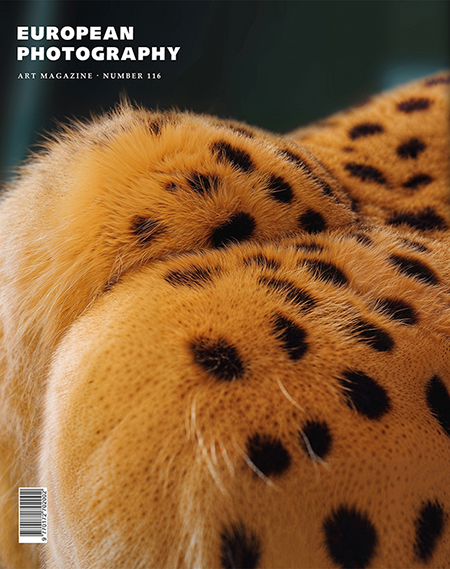
Berlin is Indescribable, by Christoph Tannert | Portfolios by Helmut Newton, Barbara Wolff, Michael Ruetz, Robert Herrmann, Thomas Florschuetz, Andreas Gehrke, Spyros Rennt, and Rafael Medina |
Photo Location Berlin, by Boris von Brauchitsch | Berlin Photo Guide | Toward a Generative Museum, by Lev Manovich |
AI portfolios by Clément Lambelet, Andreas Müller-Pohle, and Ben Millar Cole |
Book Reviews: Stephanie Kiwitt, Peter Weibel, Robert Adams, Corinne Vionnet, Peter van Agtmae, Japanese Women Photographers |
Editor’s Pick: Kurt Caviezel: Watching the World – No. 116, vol. 45, issue 2, winter 2024/2025.
Berlin: European Photography, 2024. 24 x 30 cm, 80 pages, German/English
Luna Córnea 39
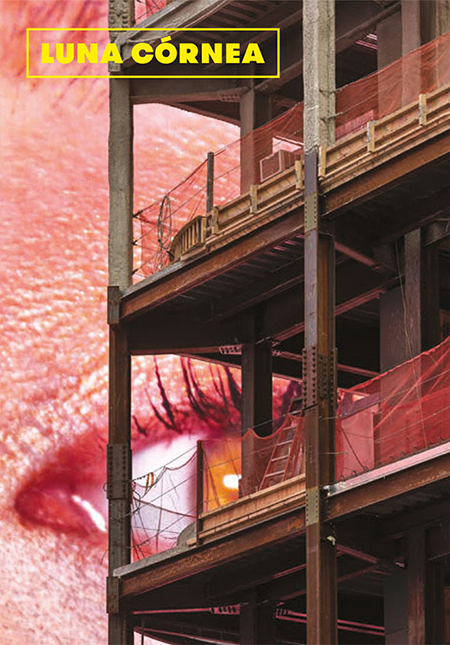
A partir del pensamiento de Guy Debord en «La sociedad del espectáculo» (1967), Luna Córnea ofrece un panorama de cómo las ideas del filósofo se han manifestado en la era digital, destacando la fusión de lo personal con lo comercial, el aumento de la vigilancia corporativa y estatal, y la reevaluación de la privacidad. Aborda también temas como la transformación del espectador en producto o espectáculo, la mercantilización de la violencia, la obsesión por los famosos, la autopromoción a través de selfies, así como las implicaciones sociales y políticas de estas dinámicas. De esta forma, esta edición invita a una reflexión sobre cómo la sociedad del espectáculo ha evolucionado para adaptarse a la era de la hiperconectividad.
Luna Córnea 39. La sociedad como espectáculo
Dirección: Alejandra Pérez Zamudio.
.jpg)
AMERICAN SELFIES
A current report about the USA. Follow on Instagram.
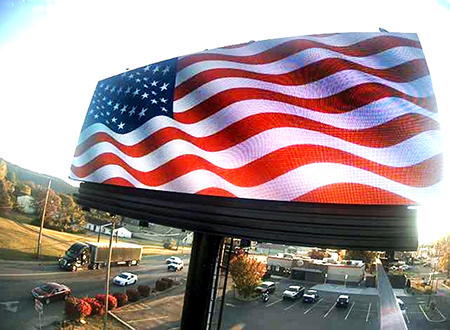
Watch and follow the series American Selfies, a current report about the USA, on Instagram.
Book/Text about surveillance pictures: 
From the panopticon to the privatization of control: surveillance cameras are everywhere, recording images non-stop, becoming the "eye of God".
But who is really "looking" there - and for what purpose? A little school of automated seeing (including some thoughts about my work) by the Swiss author Thomas Hermann.
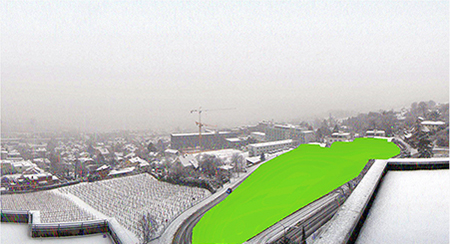
THE ILLEGAL FILM / DER ILLEGALE FILM
A film by Martin Baer and Claus Wischmann. Can one own a view?
Wolfgang Brückle & Mark Durden in Conversation with Kurt Caviezel
Also published in ArchivoZine 19, "New Media, In the Age of Visual Culture"
Limited Series. A Dialogue between Art and Automobile
October 27, 2026 – April 11, 2027
AFTER THE ALOGRITHM
March 20 – March 29, 2026
PAARE / COUPLES
June 1, 2024 – January 26, 2025
ARS TERMINI
August 25 – November 3, 2024
LICHTBLICK
March 9 – June 16, 2024
MACHINE VISION
March 3 – April 29, 2023
RESONANCES
Curator: Joan Fontcuberta · May 26 – September 4, 2022
BUILDING ILLUSIONS
December 4, 2021 – February 28, 2022
PUBLIC · PRIVATE · SECRET
Panoràmic 2020 Festival · November 4 – 29, 2020
A CHANCE FOR THE UNPREDICTABLE
November 30, 2019 – January 3, 2020
FESTIVAL DE PHOTOGRAPHIE
September 1 – 22, 2019
NEVER REAL / ALWAYS TRUE
Curator: Iván de la Nuez · March 14 – September 22, 2019
AUTOPHOTO
April 20 – September 24, 2017
TIME MAPS. Memory, Archives, Future
May 5 – July 9, 2017
PUBLIC, PRIVATE, SECRET
Curated by Charlotte Cotton · June 23, 2016 – January 8, 2017
CAMÉRA(AUTO)CONTRÔLE
Triennial 50JPG · June 1 – July 31, 2016
EGO UPDATE
September 19, 2015 – January 17, 2016
The Encyclopedia of Kurt Caviezel — Soloshow
May 13 – June 20, 2015
GLOBAL AFFAIRS — Soloshow
March 18 – May 5, 2013
GLOBAL AFFAIRS — Soloshow
February 26 – May 15, 2011
Artificial Intelligence (AI) and Photography
My project Watching The World collects live photographs from network cameras distributed across the globe — operating fully autonomously, without editorial selection, without a directing eye, and immediately visible on the network.
The cameras in our system share one condition: they are publicly accessible.
What they produce is a radical form of documentary photography: the world as it is, shaped by time, place, and contingency alone.
When AI and photography are discussed today, the conversation gravitates quickly toward image generators — algorithms that fabricate worlds from statistical patterns, producing images that are fluent, seductive, and fundamentally synthetic.
These tools are consequential, and the questions they raise are real.
But Watching The World moves in exactly the opposite direction.
It uses artificial intelligence not to generate images but to find them — to locate and display photos that were just taken a few seconds ago, that exist and could not have been created in any other way.
Where AI image generation asks what a photograph could look like, Watching The World insists on what one does look like — without the flattering mediation of a model trained to produce images people find pleasing.
Where AI image generators produce artifice, Watching The World insists on authenticity.
Reality does not perform for the camera. It simply is — and what it is turns out to be far stranger, far more compelling, and far less manageable than anything a generator has yet produced.
What appears is drastic reality: scenes that are sometimes astonishing, sometimes unsettling, sometimes oppressively strange — confrontations with moments that have never been seen before and will not recur. The principle of the real moment, captured without intention or design, is not merely preserved here; it is made radical.
Watching The World is a counter-model.
Not a nostalgic one — the latest technology, including AI, is its instrument and its method. But as a demonstration that AI can serve the real world.
A counter-model to the fantasy that the most interesting thing artificial intelligence can do with photography is to replace it.
And that is reason enough for a counter-model.
Kurt Caviezel
The Encyclopedia Of Kurt Caviezel
Rorhof, Italy, 2015
For the past 15 years, from his studio in Zurich, Kurt Caviezel has been monitoring 15,000 publicly accessible webcams located all over the world. By taking screenshots of any situation he found interesting he compiled an archive of more than 3 million images, categorizing them for recurring patterns and subjects.
The dust jacket of the book contains all 15,000 web-links used by Kurt Caviezel to create this body of work.
Red Light
Edition Patrick Frey, 2000.
During the summer months of 1997, Kurt Caviezel photographs, through his window, the interiors of cars stopping at the red light outside his apartment on a busy Zurich intersection...
Points Of View
Editor: Ulrich Binder & Bündner Kunstmuseum Chur
Texts: Beat Stutzer & Ulrich Binder
huck magazine
Read in huck magazine: Russian hacktivists are using CCTV networks to protest Putin
WIRED.com
Features the work "The Photographers" by Laura Mallonee.
The Joy of Spying on Snap-Happy Tourists With Open Webcams Everyone's a photographer now. And Kurt Caviezel takes pictures of them in the act.